
In manufacturing, precision isn’t a perk, it’s the baseline. When you’re producing leather goods at scale, the quality of each cut determines everything that follows: material yield, stitching accuracy, part uniformity, and overall profitability. Whether you manufacture belts, footwear, saddles, holsters, wallets, bags, or industrial components, leather cutting dies are the backbone of consistent, high-volume output.
They need to perform, every cycle, every batch, every order. Because in production environments, every millimeter counts and every mistake cost money. This guide breaks down what matters when selecting leather cutting dies, how different types perform, and why the right manufacturer and die press setup make all the difference.
What Are Leather Cutting Dies?
Leather cutting dies are engineered metal tools used to punch or stamp precise shapes from leather. They replace manual cutting methods and introduce consistency, speed, and scalability to factory and workshop environments.
Leather workers typically use these dies with a leather die cutting machine or clicker press. The press provides the downward force needed to cleanly shear through materials ranging from soft chrome-tan leather to thick veg-tan hides. Instead of each piece being cut by hand, every part is produced at the same dimensions, with clean edges that are ready for assembly.
In short: dies turn leatherwork into a controllable production process instead of a variable craft.
Types of Dies for Cutting Leather
Not all dies serve the same workload or production need. The most common die types used in manufacturing include:
01. Clicker Dies
Clicker dies, often referred to as leather clicker dies, are the most widely used tooling in leather production. A Pre-hard / Pre-sharp rule is bent to match the desired shape. Typically, an open back design which allows the operator to place the die as to avoid natural blemishes. They’re ideal for repetitive, uniform shapes such as:
- Wallet and bag panels
- Belt straps and blanks
- Holster patterns
- Small accessories and inserts
These dies pair with manual, swing-arm, beam, or hydraulic clicker presses. The right construction can deliver thousands of consistent cuts with minimal wear and fast cycle times.
Clicker dies are popular because they hit the sweet spot between cost, durability, and customization. When maintained properly, they deliver clean edges and fast throughput without compromising tolerances.
02. Forged Dies
Taking a step up from the Clicker Die is the more robust Forged Die. They are built from solid steel and designed to take on high-pressure, high-volume cutting. Like Clicker Dies, Forged dies feature an open back design that allows precision placement on the leather to maximize material usage. They’re used for:
- Thick or dense leather (e.g., veg-tan saddlery leather)
- Intricate shapes under heavy load
- Long production runs without tolerance drift
Because they won’t flex, crack, or deform, forged dies protect against miscuts and production errors. While they carry a higher upfront cost, they deliver long-term stability, especially in demanding production environments.
03. Steel Rule Dies
If you’re looking for a less expensive alternative to the above dies, look at Steel Rule Dies. They perform similarly to Clicker and Forged Dies, however, the pre-hard / pre-sharp cutting rule is inserted into a wood die board.
As with any cutting die, steel rule dies support both brand identity and exact fitment. For manufacturers building unique product lines or signature pieces, custom tooling enables repeatability at scale without sacrificing design.
Spotlight: Leather Clicker Dies in Production
Clicker dies are favored across industries because they balance cost-efficiency with performance. What else sets them apart?
Longevity: With proper construction and press alignment, they can deliver tens of thousands of cuts before maintenance is needed. After routine maintenance like a sharpening, they can deliver tens of thousands more cuts.
Material Compatibility: From soft glove leather to firm bridle leather, clicker dies adapt to thickness and material density when paired with the correct press. Allowing manufacturers to cut a variety of materials with one die.
Versatility: One die can support multiple product sizes or variations with strategic layout.
They’re common in factories producing footwear, belts, holsters, accessories, medical goods, pet products, tool sheaths, and more. If you’re cutting the same shape more than a few times a day, this style of die pays for itself immediately.
Leather Cutting Die Presses: Why the Machine Matters
Even the best die won’t perform if the press behind it is underpowered, misaligned, or worn out. The press determines how efficiently the die works and how long it lasts. Here are the main types used in manufacturing:
Manual or Hand-Operated Presses – Useful for small runs or thin leather. Low-pressure output limits their use in production.
Swing-Arm (Clicker) Presses – Reliable for medium output. Common in shoe factories, accessory shops, and leather goods production.
Beam Presses – Offer higher tonnage, larger cutting surfaces, and more stable pressure distribution.
Traveling Head Presses – Ideal for larger material sheets and multiple-up die layouts. Useful in high-volume manufacturing.
Hydraulic Presses – Provide the most consistent force and are preferred for forged dies, thick materials, and precision cuts.
Why the press matters – Underpowered machines cause incomplete cuts and excessive wear on dies. Misalignment leads to uneven pressure and premature dulling. The right tonnage prevents cracking, warping, and labor-intensive corrections. A quality die paired with a properly calibrated press means cleaner cuts, faster cycles, and less scrap.
Custom Shapes and Specialized Production Needs
Most manufacturers don’t rely on generic forms. Products often require dies tailored to branding, assembly specs, or downstream processes.
Custom dies can include:
- Radius corners and punch-outs
- Stitch-line alignment points
- Component nesting for material efficiency
- Logo placement and shape-specific branding
- Multi-part die sets for assembly sequences
A qualified die manufacturer will work from CAD files, physical samples, or detailed specs to produce tooling with tight tolerances. When scaling production or launching a product line, a custom die ensures repeatability and faster turnaround without manual trimming or rework.
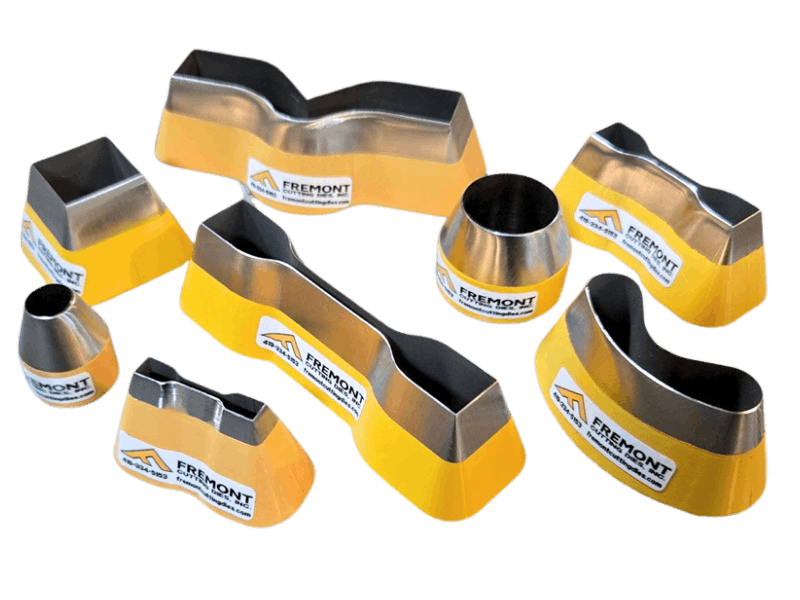
Shop Cutting Dies
Fremont Cutting Dies produces all the cutting dies your business needs, delivered right to you.
Shop our selection of on-demand ASTM Dies, ISO Dies, Die Molds, Presses, Accessories, and more.
Where Leather Cutting Dies Deliver the Most Value
The right die does more than cut shapes, it impacts every part of your workflow. Key advantages include:
- Clean edges ready for stitching, burnishing, or assembly
- Reduced material waste through precise nesting
- Faster throughput with less manual labor
- Identical parts for consistent product lines
- Scalability for both short runs and mass production
Whether you’re producing 100 pieces or 100,000, your tooling should guarantee uniform results.
Avoiding Common Mistakes
Even well-made dies fail early when misused or not maintained. Proper setup, storage, and usage will determine how long your investment lasts. Avoid these common issues to ensure you are getting the full life out of your die.
- Running a die on an underpowered press
- Cutting on improper surfaces
- Storing dies in humid or stacked environments
- Using dull tooling beyond its lifespan
- Neglecting alignment or press calibration
Choosing the Right Leather Cutting Die Manufacturer
You’re not buying craft tools, you’re investing in production infrastructure. When evaluating a supplier, look for the following:
01. Precision and Custom Capability
A shop should produce custom leather cutting dies that align perfectly with your specs. Loose tolerances lead to downstream issues.
02. Strong Material and Construction Methods
Regardless of the die you pick, it should withstand sustained pressure without separation, cracking, or distortion. Ensure the manufacturer you choose uses high-end materials that will withstand your production needs.
03. Realistic Lead Times
Lead times should match your production flow. Reorders and repeats shouldn’t force downtime. Keep this in mind and make sure you plan several weeks if you need something custom built.
04. Proof Over Promotion
Samples, portfolios, and referrals matter more than marketing claims. Quality is visible in the cut. Check out a company’s website or ask for examples of similar work they have done.
05. Maintenance and Longevity Expectations
A good die pays for itself many times over, if it’s built to last. Outside the initial build, ensure the manufacturer you choose has the capability to maintain your die long term. This will save you from looking for multiple vendors.
Final Word on Leather Cutting Dies
Leather cutting dies don’t often attract attention, but they define the quality and efficiency of your production. The right tooling eliminates guesswork and inconsistency, keeping your lines running smoothly. When your dies are built to spec, used on the right equipment, and designed with your production goals in mind, you won’t have to think about them again. Outside the standard routine maintenance and upkeep tasks of course.
If you’re looking for high-performance dies for cutting leather, custom or standard, partnering with the right manufacturer makes the difference. Have a project in mind? Reach out to our team to discuss your application, timeline, and the best options for your needs.
