
All plastics behave a little differently when stretched. Some will stretch for awhile before they break, while others resist deformation and fail with little warning. ASTM D638 gives manufacturers and testing laboratories a consistent way to measure those differences.
The standard covers tensile testing of reinforced and unreinforced plastics. It helps measure properties such as tensile strength, yield strength, tensile modulus, and elongation. Engineers can use these results to compare materials, evaluate production quality, support product development, and confirm material performance.
The test itself may look simple. A machine pulls a specimen until it breaks or the test ends. However, specimen geometry, preparation, test speed, and testing conditions can all affect the results.
Understanding those factors starts with knowing what the standard requires and why.
What Is ASTM D638?
ASTM D638 is the standard test method for tensile properties of plastics. It covers plastic materials up to 14 mm (0.55 in.) thick. The test uses a standard dumbbell-shaped test specimen. Many people also call this shape a dog bone specimen because of its narrow center and wider ends.
A universal testing machine grips the specimen at both ends and pulls it at a controlled rate. The equipment records force and deformation during the test. When required, an extensometer measures changes in specimen length. These measurements show how the plastic responds to tensile force.
For plastic films and thin sheeting less than 1.0 mm (0.04 in.) thick, ASTM D882 provides the appropriate test method instead.
What Does a Tensile Test Measure?
Tensile testing measures how a material responds when a force pulls it apart. The test can provide several important mechanical properties.
Tensile strength describes the tensile stress that a material withstands during testing. Manufacturers often use this value to compare materials or confirm that a product meets its requirements.
Yield strength identifies the stress associated with yielding when the material has a yield point. At this stage, permanent deformation begins.
Tensile modulus measures stiffness. A material with a higher modulus resists stretching more than a material with a lower modulus.
Elongation measures the change in specimen length. Elongation at yield and elongation at break can help describe how much a plastic deforms during the test.
Poisson’s ratio describes how a material changes in width relative to its change in length when stretched. ASTM D638 includes an option for determining Poisson’s ratio at room temperature.
Together, these properties give engineers useful information about how a plastic behaves under tensile loading.

Shop Tensile Test Specimen Cutting Dies
Shop our selection of on-demand ASTM Dies, ISO Dies, Die Molds, Presses, and more.
Understanding the Stress-Strain Curve
The data collected during tensile strength testing can produce a stress-strain curve. Stress represents force in relation to the specimen’s original cross-sectional area. Strain represents the change in length relative to its original length. Plotting these values shows how the material responds as the test progresses.
The shape of the curve can reveal stiffness, yielding, deformation, and failure behavior. It also helps engineers compare materials that may respond differently even when they have similar tensile strength values. For this reason, tensile testing provides more information than a single number at the point of failure.
How Does the Test Work?
Testing begins with a specimen made to the required geometry. Depending on the material, a lab may mold, machine, or die cut the specimen. For suitable sheet materials, a specimen cutting die offers an efficient way to produce the same shape repeatedly.
The lab then measures and conditions the specimens as required. Defined conditions for pretreatment, temperature, and humidity help control variables before testing. To ensure unwanted variables do not skew your test results.
The operator places each specimen into a tensile testing machine and sets up the required strain measurement equipment. The machine pulls the specimen at a specified testing speed while recording data throughout the test. The testing team can then use that data to calculate the required tensile properties.
Consistent preparation matters. Changes in specimen dimensions, preparation, test speed, conditioning, or environment can affect the results.
Why Use Dumbbell-Shaped Test Specimens?
Dumbbell-shaped test specimens have wider ends and a narrower section in the middle. The wider ends provide space for the machine grips, while the reduced section creates the primary test region. This geometry helps researchers evaluate the material away from the grips.
Consistency also matters when producing specimens. Changes in dimensions, edges, thickness, or preparation can add unwanted variables to a test.
You may hear these samples called dumbbell-shaped test specimens, dumbbell specimens, or dog bone specimens. These terms generally describe the familiar tensile specimen shape. For a deeper look at the geometry and its purpose, read our guide to dog bone tensile test specimens.
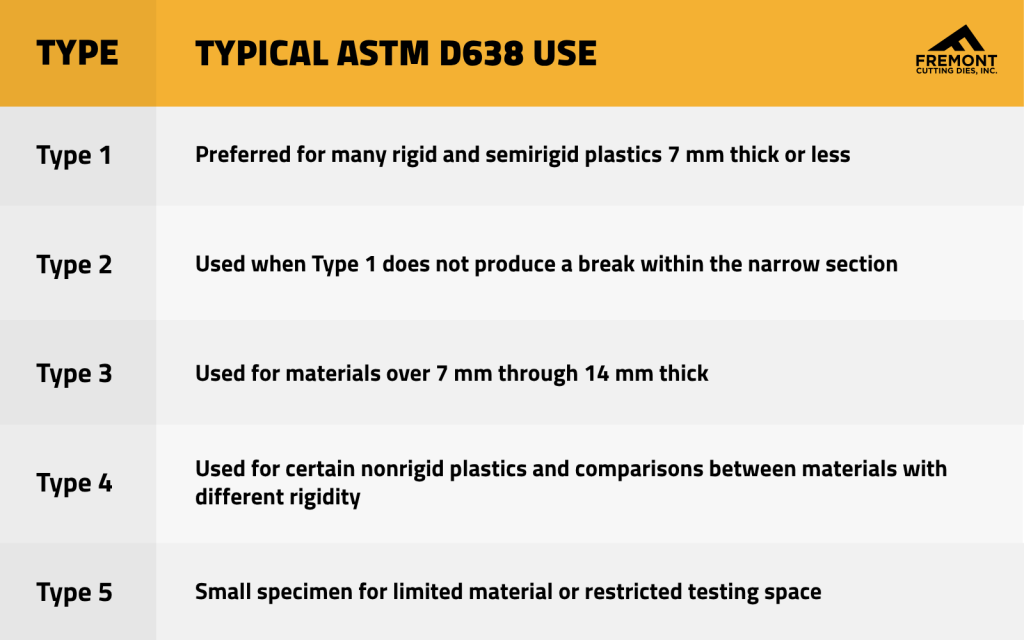
Choosing Between Type I, II, III, IV, and V
The standard includes five primary specimen geometries. Material thickness, rigidity, available material, and test behavior can help determine which type to use.
Type I
The ASTM D638 Type I specimen die produces the preferred specimen for many rigid and semirigid plastics up to 7 mm (0.28 in.) thick. This is the geometry most people associate with the standard.
Type II
The ASTM D638 Type II specimen die provides an alternative when a Type I specimen does not break within its narrow section. The Type II design uses a narrower reduced section than Type I.
Type III
The ASTM D638 Type III specimen die applies to materials over 7 mm (0.28 in.) through 14 mm (0.55 in.) thick. Its larger geometry accommodates this thicker material range.
Type IV
The ASTM D638 Type IV specimen die works with certain nonrigid plastics. It also supports direct comparisons between materials with different rigidity characteristics.
Type V
The ASTM D638 Type V specimen die creates the smallest of the five primary specimen types. Type V works well when only a small amount of material is available. Its compact size also allows several specimens to fit within a limited testing space.
Why Specimen Preparation Matters
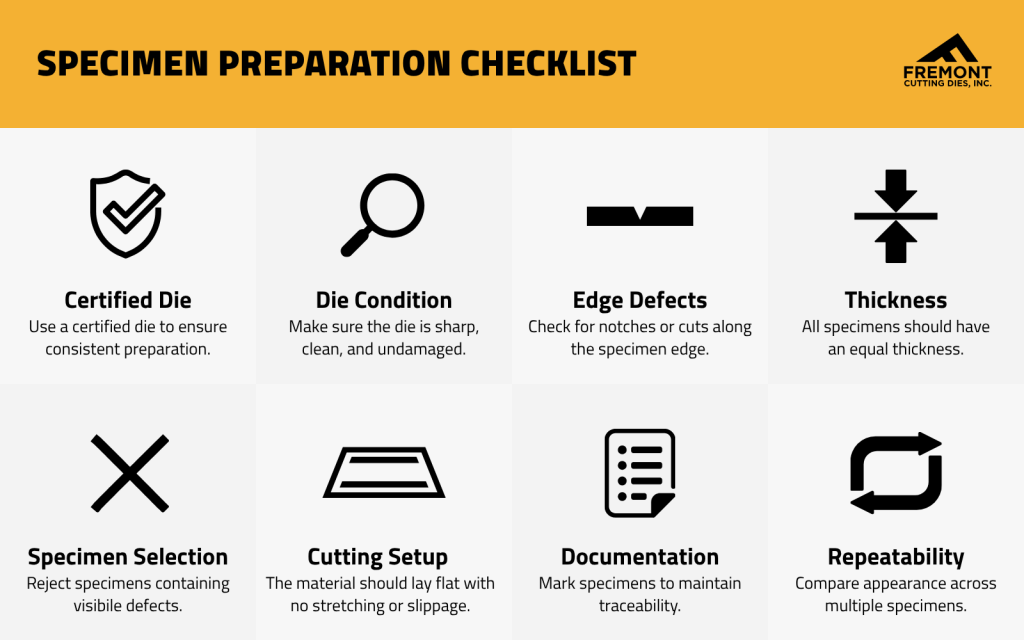
A precise testing machine cannot correct an inconsistent specimen. Small differences in specimen dimensions, edges, thickness, or preparation can introduce another variable into the test. That matters when a manufacturer compares batches, materials, suppliers, or production processes. Because tensile results will vary with specimen preparation, dimensions, edges, and thickness.
For direct comparisons, all specimens should have equal thickness because thickness can affect tensile results. For die-cuttable materials, we recommend using a certified cutting die to create the required test specimen. This consistency helps ensure each test starts with a properly prepared specimen. It also reduces avoidable variation before testing begins.
What Are the Limitations of Tensile Test Results?
Tensile test results describe how a material performs under the conditions of the test. They do not predict performance under every real-world condition.
Plastics can respond differently as temperature, environment, loading rate, and load duration change. Some applications may require additional testing. Impact or creep testing can provide data for conditions that differ from the tensile test.
Getting Reliable Tensile Test Results
ASTM D638 gives manufacturers, engineers, and laboratories a common method for evaluating tensile properties and producing comparable results. Reliable testing requires the right specimen as well as the right equipment and procedure. Material thickness, rigidity, specimen preparation, conditioning, test speed, and environment can all influence the final data.
Always use the current version of the standard and review any applicable material specifications before selecting a specimen or establishing a testing procedure.
Once you know which specimen your application requires, Fremont Cutting Dies can provide the right cutting die. We offer Types I through V in both Imperial and Metric configurations. Our certified dies will produce consistent specimens and help you start each tensile test with one less headache.
