
In today’s competitive manufacturing landscape, material selection directly impacts cost, reliability, and customer satisfaction. Bronze has been an important material for centuries. Now, it is becoming more popular with companies that want to make parts last longer and save money. When engineered with modern CNC machining, bronze offers precision, repeatability, and scalability across diverse industries like marine, HVAC, aerospace, and heavy equipment.
This guide is for decision-makers, engineers, operations leaders, and anyone else who finds themselves evaluating a material shift or producing bronze parts. You’ll come away with a comprehensive understanding of:
What Is Bronze CNC Machining?
Bronze CNC machining refers to using computer-controlled equipment, such as mills, lathes, and routers, to shape bronze stock into various parts. Through CNC machining, companies can produce complex part geometries with repeatable tolerances, excellent surface finishes, and fast turnaround. Whether producing one-off prototypes or scaling up for high-volume production, CNC machining maximizes the performance potential of bronze while maintaining manufacturing efficiency.
Key Benefits of Bronze
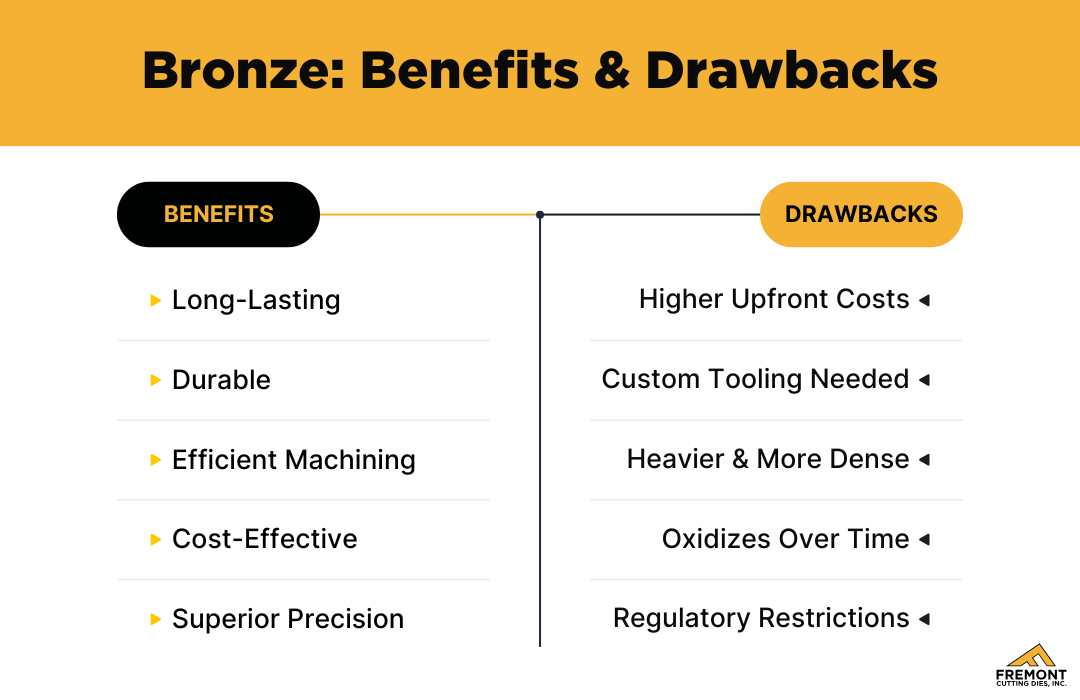
Bronze offers a compelling mix of mechanical and cost-saving advantages. Especially when chosen as a replacement for more maintenance-prone materials. If you’re considering switching to bronze, you may experience some of the following benefits:
01: Improved Lifecycle Value
Parts made from bronze often last significantly longer than those made from other materials. Particularly in high-load or high-friction applications. This durability translates into fewer service interruptions, lower maintenance costs, and improved ROI over time.
02: Machining Efficiency
Bronze machines cleanly, especially in free-machining grades like C932. We’ll talk more different types of bronze later. More efficient machining means lower production costs especially when compared to hard to machine materials.
03: Cost-Effective Material Switching
When manufacturers switch to bronze, they often find longer service life and better reliability offset the higher material cost. Especially in bushings, bearings, or rotating assemblies that fail frequently when made from less durable alloys.
04: Superior Precision
CNC machining enables bronze parts to meet demanding dimensional tolerances. Tight sealing surfaces, pressure-fit components, and precision connectors benefit from bronze’s inherent dimensional stability and thermal conductivity. Overall allowing you to maintain tight part tolerances and production quality.
Drawbacks of Bronze Parts
While bronze offers a wide range of performance benefits, it’s important to understand the material’s limitations. When comparing it to alternatives like aluminum, brass, or engineered plastics the differences are vast. Before making your decision consider the following drawbacks of bronze:
01: Higher Upfront Material Cost
Bronze alloys are typically more expensive per pound than aluminum, mild steel, or plastics. For companies working within tight material budgets or large-scale production volumes, the initial cost can be a concern. However, bronze often provides an extended part life and lower failure rates over time, which offsets this.
02: Tooling Considerations for Harder Alloys
Certain bronze grades, such as aluminum bronze, are harder and more abrasive. These require slower machining speeds, rigid setups, and high-quality carbide tooling. These adjustments can add complexity to the production process, especially for shops unfamiliar with bronze.
03: Weight & Density
Bronze is heavier than aluminum and plastic. For some applications in industries like aerospace or portable products, weight it a critical factor. In these cases, bronze may not be the best choice. Unless its strength or wear resistance makes the extra weight worthwhile.
04: Appearance Over Time
Bronze can oxidize over time, developing a surface patina. Many people consider this visually appealing in architectural or artistic applications. However, it may not be desirable for components where appearance matters or where oxidation might interfere with function.
05: Regulatory Restrictions on Lead Content
Some bronze alloys, particularly older or traditional bearing bronzes, contain lead to improve machinability. While this doesn’t affect every application, it can be an issue for industries subject to RoHS, REACH, or FDA compliance. Fortunately, lead-free alternatives like bismuth bronze are available.
When Brass, Aluminum, or Steel Fall Short
Material selection impacts more than just unit price. It affects total lifecycle cost, performance under stress, and compatibility with the working environment. Bronze is typically outperforms other materials in the following areas:
-
- Aluminum is lightweight and easy to machine but lacks the strength and abrasion resistance needed for high-wear parts. If your part is subject to harsh environments or is wearing down quickly, you may wish to switch to bronze.
- Steel is strong but prone to corrosion unless coated or treated. It also typically causes higher tool wear during machining. If you’re looking improve machineability or lower production costs, consider bronze.
- Brass, while easy to machine, lacks the hardness and long-term durability of most bronze. If you’re looking to create parts that stand the test of time, you may wish to consider a material change.
- Plastic can be a more cost-effective lightweight solution. However, it generally under performs in high-temperature, high-pressure, or chemical-exposed environments. If your part is subject to any of these, bronze is probably a better choice.
Bronze sits at the intersection of strength, wear resistance, and machinability. Making it the ideal upgrade for companies dealing with premature part failure, harsh environments, or excessive maintenance cycles.
Bronze Alloy Options & Typical Use Cases
Picking the right bronze alloy is essential to align material properties with your part’s performance demands, manufacturing feasibility, and budget considerations. Here is a detailed look at ten common bronze alloys used in CNC machining:
01. Bearing Bronze (C932, SAE 660) – This happens to be one of the most machine-friendly bronze alloys. It blends around 90% copper with tin and small amounts of lead or phosphorus to optimize chip flow. Its low-friction qualities and high load capacity make it ideal for components like bushings, thrust washers, and slow-speed gears.
02. Phosphor Bronze – By adding tin and phosphorus, this alloy gains fatigue resistance, wear resistance, and corrosion hardness. Manufacturers frequently use it in applications such as marine fasteners, electrical terminals, and precision springs. Especially when repeated motion and moisture exposure are factors.
03. Aluminum Bronze – This heavy-duty alloy uses 5–11% aluminum (sometimes with nickel or iron) to achieve strength close to steel and outstanding corrosion resistance. Though machining requires careful control and carbide tooling, the payoff comes in superior performance. In the real world, you often see this in valve bodies, propeller shafts, hydraulic components, and offshore equipment.
04. Silicon Bronze – This alloy has 2–3% silicon and small amounts of additives like manganese. It offers a good balance of corrosion resistance, color stability, and machinability. Architects and designers commonly use it in architectural hardware, ornamental fittings, and artistic elements due to its appealing finish.
05. Bismuth Bronze (Lead-Free) – This eco-conscious alternative uses bismuth (typically 1–3%) instead of lead to maintain machinability while meeting lead-free regulations. Especially useful for potable-water plumbing, food-safe applications, and industries sensitive to lead content.
06. Tin Bronze (High-Tin Alloys) – These alloys contain 10–12% tin and exhibit strength, corrosion resistance, and heat endurance. Companies use them in pump housings, heavy-load bearings, valve guides, and industrial gears. Especially where tin’s mechanical performance provides longer life at elevated temperatures.
07. Bell Bronze (Bell Metal / B20) – With roughly 20% tin, this alloy offers acoustic capabilities that make it perfect for musical instruments such as bells and cymbals. It’s not easy to machine or for heavy loads, but its resonance and tonal clarity hold unmatched value in acoustical applications.
08. Manganese Bronze – A robust alternative that combines copper, zinc, and manganese (sometimes with lead, iron, or aluminum). This alloy offers exceptional tensile strength and wear resistance. A go-to for industrial gears, high-stress shafts, and heavy-duty fittings in demanding environments.
09. Arsenical Bronze – Alloyed with tin and trace amounts of arsenic, this variant adds durability and a thin oxide layer that enhances heat resistance and corrosion protection. Often seen in heat exchangers, boiler parts, or niche environments, it provides performance where conventional bronzes may falter.
10. Speculum Metal – A high-tin alloy (20–30%) prized for its mirror-like finish and hardness. Speculum metal works well in optical or decorative settings. Its brittleness makes machining a challenge, yet its reflective surface is ideal for special-purpose or display pieces.
Choosing the Right Alloy
As you can see, each bronze variant brings unique strengths and weaknesses. Understanding these alloys enables you to select the right bronze for your project. Capturing the best-match for performance, cost-effectiveness, and manufacturability. Whether transitioning from plastic, aluminum, or steel, this knowledge supports more informed decisions and stronger long-term value for your parts. Don’t forget about these key points:
-
- C932 and Bismuth Bronzes offer great machinability and wear resistance for precision mechanical parts.
- Phosphor and Aluminum Bronzes shine in heavy-wear, high-load, or corrosive environments.
- Silicon Bronze combines aesthetic appeal with structural integrity in visible components.
- Tin, Bell, and Manganese Bronzes cover niches like high-temperature use, acoustic performance, and industrial toughness.
- Arsenical and Speculum Bronzes serve specialized applications in heat-critical or visual-sensitive contexts.
Production Insights & Best Practices
Machining bronze effectively requires attention to tool selection, speed, chip evacuation, and vibration control. Carbide tools with positive rake angles and chip breakers are essential, particularly for harder alloys like aluminum bronze. You must dial in speeds and feeds to avoid work hardening and maintain surface finish.
Flood coolant is the best way to dissipate heat and improve tool life. In some cases, mist coolant or even dry machining may be acceptable, depending on the alloy. Securing your parts will avoid chatter or dimension loss during turning or milling operations.
Inspection protocols, especially first-article inspection (FAI), in-process gauging, and final CMM checks, are vital for components that interface with fluid systems, motors, or load-bearing assemblies. Dimensional stability, surface roughness, and thread quality must all meet spec to avoid performance issues in the field.
Finishing & Assembly Considerations
CNC machined bronze parts typically have an attractive finish straight off the machine. However, polishing, bead blasting, or applying chemical patinas can enhance your surface finish. In decorative or architectural applications, a satin or mirror polish is often preferred. Though your part may not need any finishing beyond the machine finish.
Protective coatings like clear lacquer, conversion coatings, or wax sealants can preserve the bronze finish and resist oxidation. In cases where sealing or conductivity is important, final cleaning via ultrasonic wash or solvent bath ensures no residue interferes with assembly.
During production, we offer additional services such as deburring, stress relieving. We also can perform secondary operations like press-fitting or thread insertion, making the bronze component truly turnkey.
Making Your Final Decision
Companies that switch to bronze often report a measurable reduction in warranty claims, customer complaints, and downtime. Our can help you evaluate your current materials and identify if bronze is an appropriate substitute. We consider your application’s wear patterns, exposure, and cost-per-use.
We Offer:
-
- Full CAD/CAM Support & Consulting
- Prototyping through High-Volume Production
- In-House Alloy Knowledge for Most Alloys
- Post-Processing & Assembly Options
- Quality Systems Aligned with ISO & Industry-Specific Requirements
If your current parts aren’t performing, or you’re exploring material changes to reduce long-term costs, let’s talk. Contact us or simply request a quote and we can discuss your CNC machining needs. Then we’ll deliver the quality, precision, and service your production demands.
