
Brass CNC machining is a popular choice for producing precision parts across industries like plumbing, electronics, and aerospace. Thanks to brass’s excellent machinability and unique material properties, manufacturers can create high-performance components with tight tolerances and minimal post-processing.
However, like any material, brass comes with both advantages and disadvantages. In this guide, we’ll walk you through the benefits, drawbacks, common applications, and available brass grades to help you decide if CNC machining a brass part is the right fit for your next project.
What is Brass CNC Machining?
Brass CNC machining involves using computer-controlled machines to precisely cut, drill, and shape brass stock into a finished part. Due to its soft nature and low tool wear, brass is considered one of the easiest metals to machine, offering quick turnaround and consistent part quality.
Brass is primarily composed of copper and zinc, though its properties can be fine-tuned by alloying with lead, tin, iron, or aluminum. These variations impact everything from corrosion resistance to finish quality and cost, making it important to choose the right brass grade for your application.
Common CNC Machined Brass Parts
Brass has a wide variety of real-world applications. However, its composition has some disadvantages that may mean its not suited for your specific application. The following is a small list of the most common components made from brass:
Benefits of Brass CNC Machining
CNC machining brass parts delivers a unique combination of speed, precision, and performance. Below are the top reasons a manufacturer like us might choose brass for a machined parts:
01: Excellent Machinability
As previously stated, brass is one of the easiest metals to machine, especially when using a CNC. Alloys like C360 allow for high-speed cutting with minimal tool wear, resulting in shorter production times and lower costs. Clean chip formation and tight tolerances make it ideal for detailed parts and complex geometries.
02: Corrosion Resistance
Many brass alloys are naturally resistant to corrosion, especially in water-based or mild environments. Naval Brass (C464) is a good example, appearing often in marine and plumbing applications. This makes brass a smart choice for parts exposed to moisture or outdoor conditions.
03: Minimal Post-Processing
Parts produced through brass CNC machining often come off the machine with a smooth finish. In many cases, no additional polishing or coating is needed, which reduces labor and turnaround time. If desired, brass also accepts a variety of surface finishes and coatings.
04: Strength & Durability
Brass offers a solid balance between hardness and malleability. Stronger than aluminum and easier to work with than steel, brass is suitable for moderate-stress applications. It holds up well over time while maintaining its dimensional integrity.
05: High Precision & Seal Quality
Brass can have exceptionally tight tolerances, which is essential for applications like valves, nozzles, or fluid fittings. Its stability and ability to form a tight seal make it popular for systems that require leak-free connections. This precision helps reduce rework and part failure in the field.
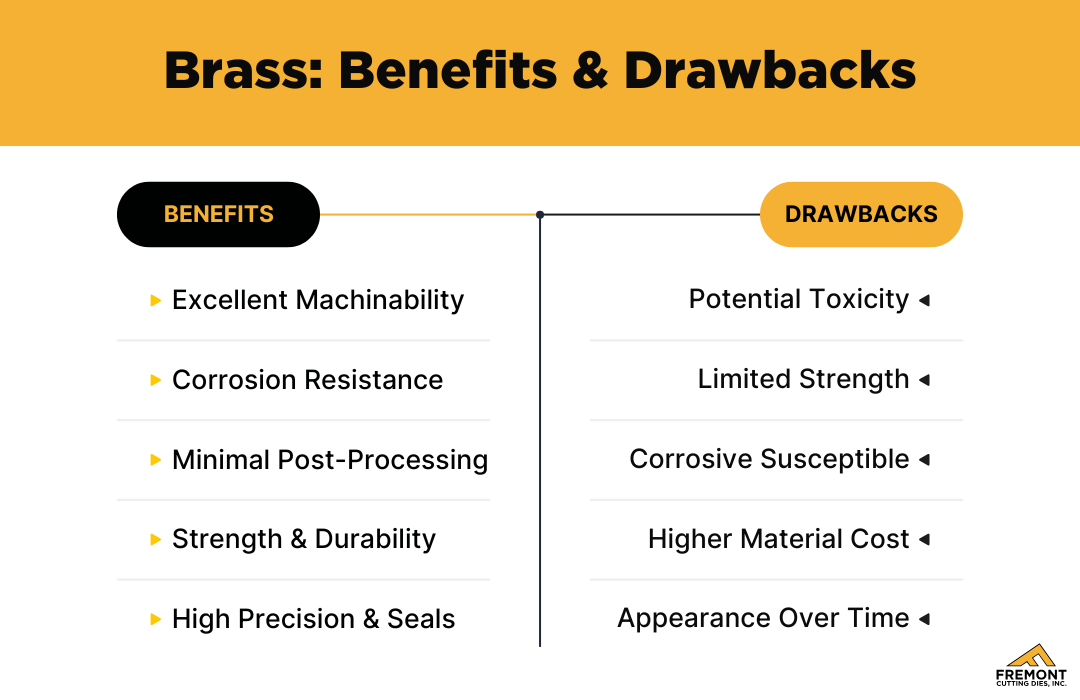
Drawbacks of Brass Parts
Despite its advantages, brass isn’t ideal for every application. It has its share of disadvantages that can ultimately make it the worst choice for a part. Before you decide, consider the following:
01: Potential Toxicity
Some brass alloys contain lead, which can make them unsuitable for medical or food-contact components. Considering the final use of your part and any applicable rules and regulations is important.
02: Limited Strength
Overall brass is a pretty strong material. However, it is not as strong or resistant to wear as harder metals like steel or titanium. This makes it a bad choice for parts that face high stress or impact over long periods.
03: Susceptible to Certain Corrosives
While corrosion-resistant in some environments, like salt water, brass can degrade when exposed to acids, ammonia, or amines. If you are looking for corrosion resistance you should consider stainless steel or even aluminum.
04: Higher Material Cost
Brass is generally more expensive than aluminum or mild steel, which may affect budgets for large production runs. To keep the cost per part down, you should consider other materials like steel or aluminum.
05: Appearance Over Time
Brass naturally tarnishes over time, developing a dull patina. This may be undesirable for visible or cosmetic parts. Consider applying a protective coating or choosing a more visually appealing metal like titanium or stainless steel.
Brass Grades for CNC Machining
If you’re on the fence about using brass, there is one one thing to consider. Several different grades of brass, or brass alloys, exist for you to choose from. Each offers unique mechanical and chemical properties:
C360(Free Machining Brass)
- Composition: 60-63% copper, 33-37% zinc, 2.5-3% lead
- Extremely machinable and commonly used
- Not ideal for acidic environments due to corrosion risk
C230(Red Brass / Nordic Brass)
- Composition: 85% copper, 15% zinc
- Good corrosion resistance and workability
- Often used in plumbing systems
C220(Commercial Bronze)
- Composition: 89-91% copper, .5% lead or iron, and the remainder zinc
- Technically a brass alloy
- Frequently used in architectural elements and fixtures
C464(Naval Brass)
- Composition: 59% copper, 40% zinc, 1% tin
- Excellent resistance to saltwater and dezincification
- Common in marine and underwater applications
Is a Brass Part Right for You?
Brass is a proven option for creating high-quality parts. Especially when ease of machining, sealing capabilities, or corrosion resistance are key factors. However, material cost, strength requirements, and the potential need for lead-free alloys should all be considered before making your final selection. If you feel Brass is a good fit for your next project, request a quote or contact us and we can discuss your CNC machining needs.
